Douglas Ritter has been a year-round resident of the Outer Cape since 1997. He first came to Cape Cod in 1987 with a fellowship in painting from the Fine Arts Work Center in Provincetown. He has taught painting, design, drawing and color theory within the BFA Programs of the Corcoran School of Art, Rhode Island School of Design, and the Savannah College of Art and Design, and currently is on the faculty of the the Museum School of the Provincetown Art Association and Museum. He holds degrees in painting from the University of Maryland (MFA 1987) where he studied with Ann Truitt and Nicholas Krushnick, and the Philadelphia College of Art (BFA 1983), as well as studies with Temple University in Rome, Italy. Awards and grants include a 1998 Maryland State Arts Council grant in 2-dimensional media, 1990 National Endowment for the Arts Fellowship in Painting, 1989-90 SECCA/R.J. Reynolds Fellowship from the Southeastern Center for Contemporary Art, and a residency/fellowship from the Fine Arts Work Center.

Solo Exhibitions include School 33 Art Center, Baltimore, Maryland, Hudson D. Walker Gallery, Provincetown, Massachusetts, Elon College, Burlington, North Carolina, Julie Heller Gallery in Provincetown, MA. His work is in the permanent Collection of the DeCordova Museum in Lincoln, Massachusetts, and numerous private collections. His work is represented by the Schoolhouse Gallery in Provincetown, Massachusetts.

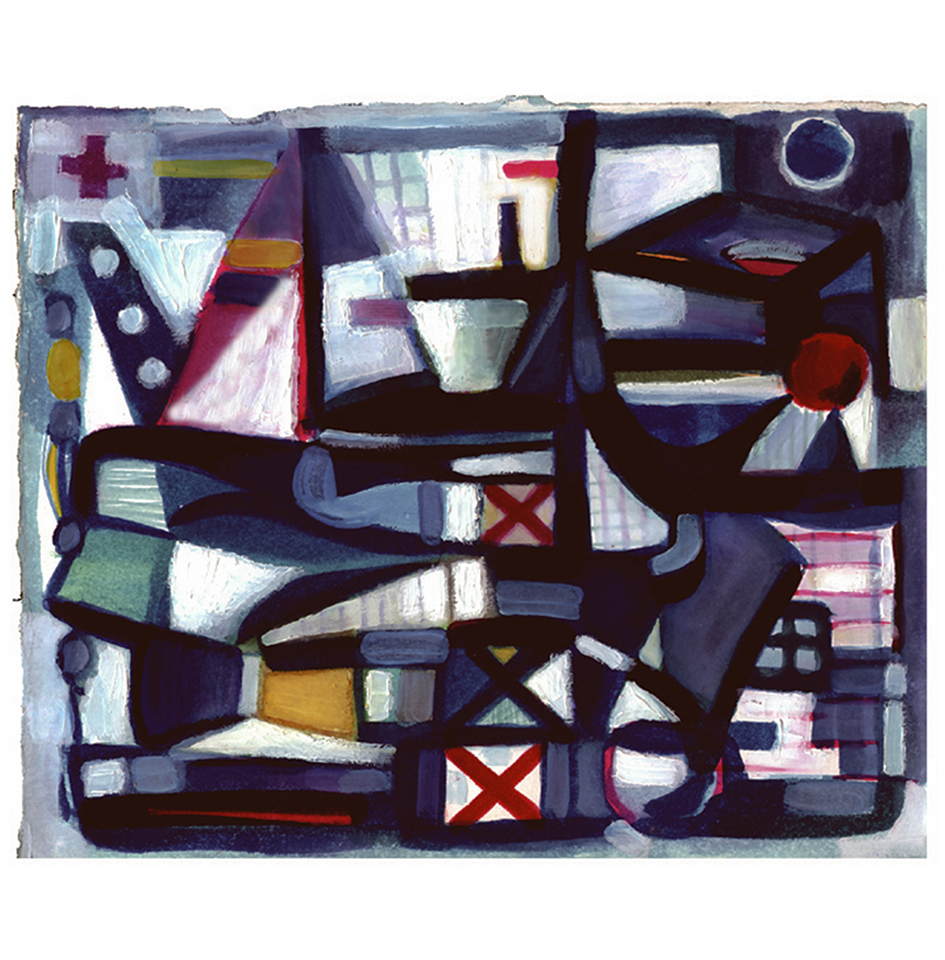
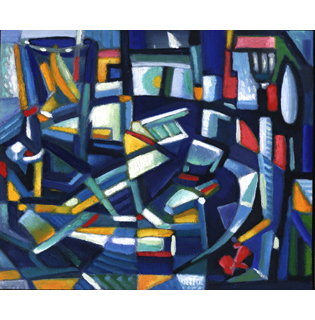
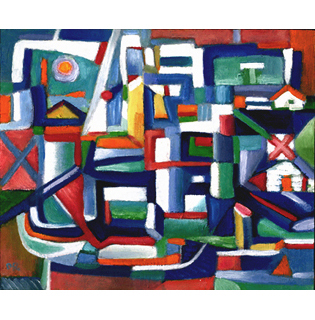
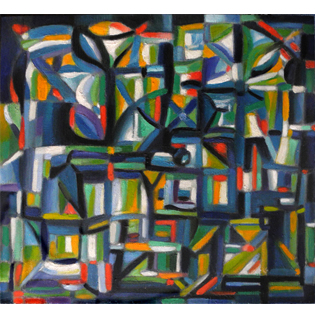
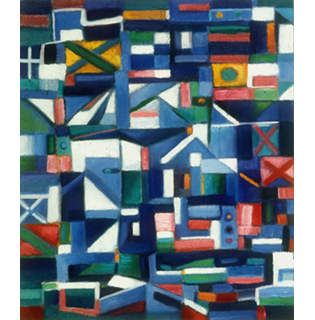
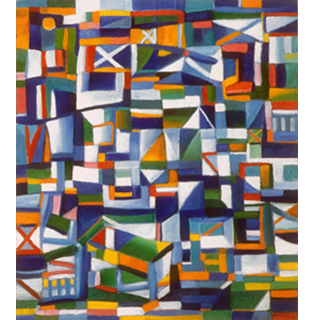
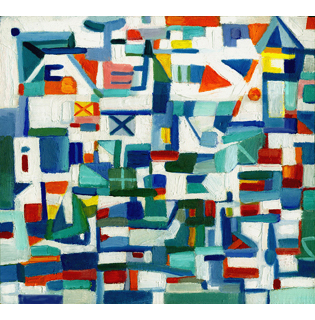
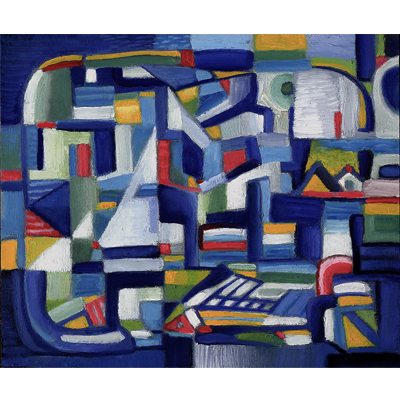
Playing the tensions between surface and space, color and shape, Painter Doug Ritter creates a kind of code, an elemental, symbolic visual language, to describe his experience of place, particularly this place, Provincetown, and life in the maritime environment. There is clearly a narrative instinct in the work, but mostly, through the structure of the painting, he is "making a path between things." Ritter throws up flags of primary color, roof lines, cottage gardens, fishing boats, like a mariner's semaphore, embedding his post verbal story in a mosaic of reductive form that echoes the spirit of early modernists.

Ritter was a Visual Arts Fellow at the Fine Arts Work Center in 1987-88. Then in 1991, he returned for a year to manage the Brewster Street Apartments, now a part of the FAWC. He was in Washington, DC for 5 years. Ritter left his job on the faculty at the Corcoran School of Art in Washington, DC, and returned to Provincetown as Visual Coordinator at the renowned Fine Arts Work Center on Pearl Street. The change from urban environment to marine environment is reflected in his new paintings. When those familiar with his work note the change, Ritter explains that these paintings are his response to the "gift of being here" again. This work is more about creating structures that bring together the immediate sensual experience and the memory of place or event, embracing "the active space between sensation and memory." In these mostly small paintings Ritter, gathers shards of bright color, creating abstraction out of real experience and the memory of real place.

- Eileen Kennedy
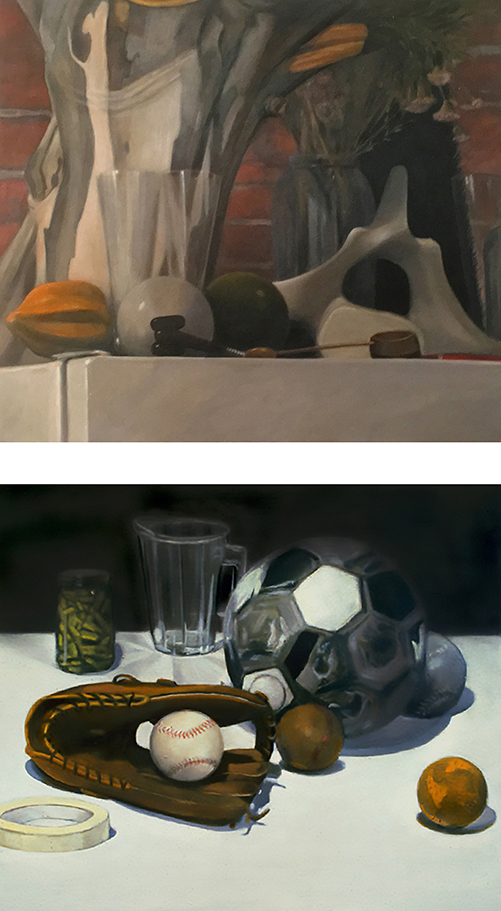
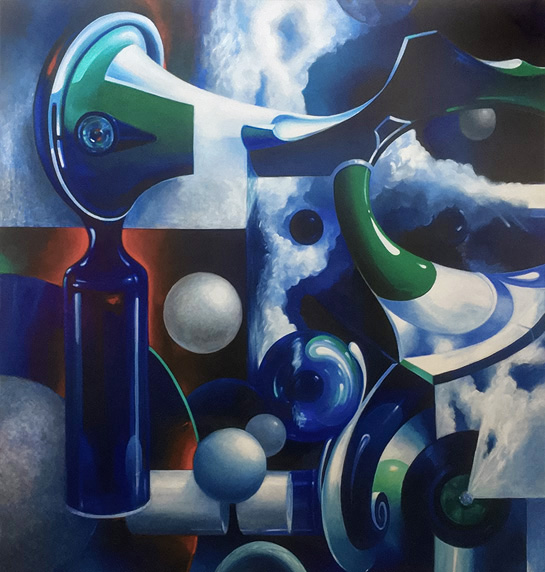
These images are representative of work done over the last six years, are all similar in scale- the paintings are generally 12 to 14 inches in their smallest dimension, painted on wood panel. They are an involvement with composition and formality, and reference aspects of representation, abstraction, and symbolization. There is an association with an actual place or event that serves as an armature for the activity of painting, and a stretching of meaning from something quite specific to a generic or more universal representation.
1, 2, 3, 4, 5, 6, 7, 8, 9, 10, 11, 12, 13, 14, 15, 16, 17, 18, 19, 20

Working reductively within a given composition, and abandoning space as an ordering principle to a more automatic, calligraphic and surface oriented structure, the paintings develop a complex syntax of simplified form.


c.2006 South Wellfleet Project Space
508. 349. 0976
dpritter@earthlink.net